Honorable mention:
The "Running Man" Icon:

Source: 1000Logos.
What "was" and "is" AOL are two very different things. First of all, AOL was, at its prime aka early days, a company that provided a range of services online, more particularly known for its dial-up service, which was established on 1991 and came to an end on 2025.[1]. Nowadays, it is a company that mainly offers news and email services, now being fully part of Yahoo! ever since 2021 when Apollo Global Management acquired it[2]. Regardless of the time period, it is a digital media company that was founded in 1985 by Steve Case, Jim Kimsey, William von Meister, and Marc Seriff, being a relatively small service provider for the internet in Vienna, Virginia. During this time, it was mainly made for Macintosh computers as Apple began steadily rising the leagues. Later on in 1991 and 1997 respectively, the company would then go on to create their dial-up service and then their instant messanger service (AIM), being mostly known for such creations. These creations practically instigated and properly began to develop the early digital community, allowing for the ease of communication to other people[2]. AOL was originally named the "Quantum Computer Service" when it was first created, later being changed to "America Online" in 1989. As time went by, it then officially changed to "AOL" in 2005 for good, a name most people nowadays recognize[2].
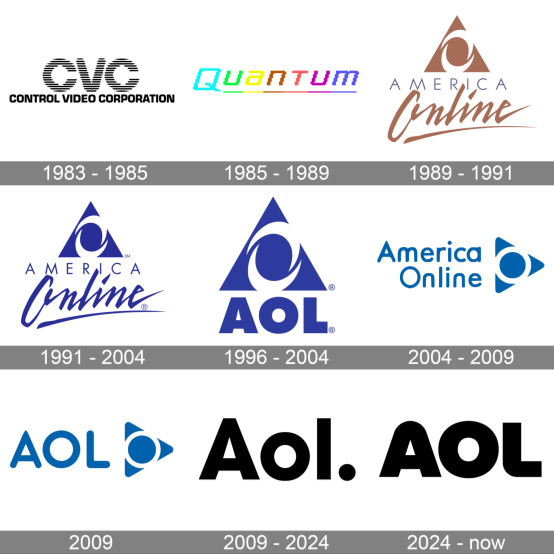
Source: 1000Logos.
From the above logo collage:
Honorable mention:
The "Running Man" Icon:
Source: 1000Logos.
In the early days of AOL, more specifically when its dial-up and instant messanger service were created and officially released to the public in 1991 and 1997 respectively, your average day-to-day person was mainly using it for simple email communication, work-related inquires and interactions with costumers, researching and reading the latest news reports, help with finances, keeping in touch with friends and family, general ease of communication to others, and even for education-related reasons[4]. Many people during this time said they used AOL's services since it they very "user friendly" [4]. This was a big deal during the time as many individuals were still relatively new to the internet and unsure of what to even do. This meant AOL was certainly rising rapily in popularity—no doubt in net worth as well.
Many users of AOL's services began to garner their hours from uniquely-decorated discs that were tremendous in numbers during a massive "carpet bomb" like campaign in 1993 where they gave millions of hours of their services for free, most likely spending over millions upon millions of dollars to do so. Their methods to distribute these discs included but are certainly not limited to: cereal boxes, magazines, video game boxes, retail and other company collaborations such as Blockbuster and McDonalds, and through direct mailing.[5]. This campaign was more than likely done to try and coerce others to sign up for their services and join the already huge amount of individuals who have already done so. Below is a smorgasbord of some of the many discs AOL sent out for their huge campaign:
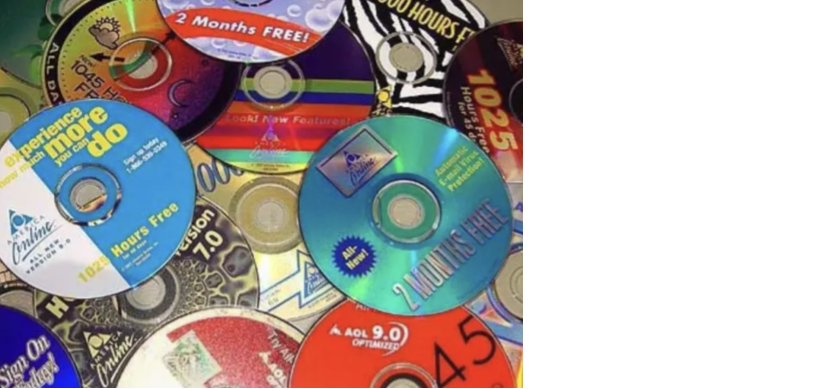
Source: Business Insider.
Nowadays, most users who still use AOL's services after their instant messaging service was canceled in 2017 and their dial-up service in 2025 more than likely do so from their phone app simply named "AOL." The app is as of December 4th, 2025, available for both the IOS and Andriod platforms and, to reiterate, provides an area to access their mail, weather, and news [6]. The logo for the app can be viewed below:

Source: Google Play.
Unfortunately, mp3 files are a paid feature of Neocities, so, instead, here are the links containing the files of the nostalgic AOL Instant Messenger sounds:
FilesDone - Notified the user when their file download or transfer was finished[7].
IM - Short for "instant message." Alerted the user whenever they received an instant message[7].
Welcome - Executed when the user logged into AOL's dial-up service[7].
Goodbye - Played whenever the user logged out of AOL's dial-up service[7].
You've Got Mail! - The extremely well-known sound. Played whenever you received mail. It was recorded by Eldwood Edwards in 1989. He has sadly since passed at the age of 74 in 2024[8].
Sometime during 2001, when AOL was still known as "America Online," it ended up merging with Time Warner. Time Warner was, roughly put, a company that was founded by Steve Ross and was a sort of mesh between Time Inc. and Warner Communications, both being massive at the time[9]. After not even a while of being merged together, it began to become apparent that both companies did not exactly agree with one another with the topics and themes they dealt with; things turned upside down quickly[10]. Interestingly enough, this was also taking place during the time in which the "dotcom bubble" event began. The dotcom bubble event was, simply put, a point of time in which the stock market saw extreme growth for many dot-com companies during the 1980-2000s time zone. Right as the 2000s hit, many of the dot-com companies' stock values began to plummit rapidly because of "irrational stock valuations"[11]. Since AOL was one of the many dot-com-owning companies who's stock was effected, it ended up suffering massively, losing billions of its net worth. Later in 2009, AOL and Time Warner finally disbanded, ending the badly-made choice to merge, causing the company name to go from "America Online" to the current "AOL," and discountinuing the below logo[2]:
(2000-2008)

Source: Wikipedia.
However, because of the dotcom bubble, AOL continued to spiral further and further down in net worth. This is often seen as the starting point in AOL's decline[2].
Overall, AOL has certainly gone through a lot and has done plenty ever since its establishment in 1991: from a dial-up service that millions used till its unfortunate end in 2025 due to everyone moving on to more modern technologies, an insta-messanger service that many still used but was discounted in 2017 because of the newer texting apps and services, getting into its fair share of impactful events such as the dotcom bubble and its merge with Time Warner, sending out millions of discs in all sorts of ways to promote their services, and making a memorable and lovable mascot. Based off of one's own interpretation, it seems as if AOL is likely to either continue by itself, gaining most of its present-day usage out of its app, or, the company will go on until it merges with another company and/or gets sold. Either of which are the inevitable outcome as it continues to get left behind by popular and engaged-in services.
AOL Yellow Guy Dancing GIF (reminiscent of early 1990s internet humor)

Source: Tenor.
The AOL Instant Messenger Logo. Features The Running Man And The Blue Triangle (more than likely one of the more famous AOL logos)

Source: SeekLogo.
AOL Startup GIF (annoying sound not included but can be found here. "Don't get on/get off the phone!")
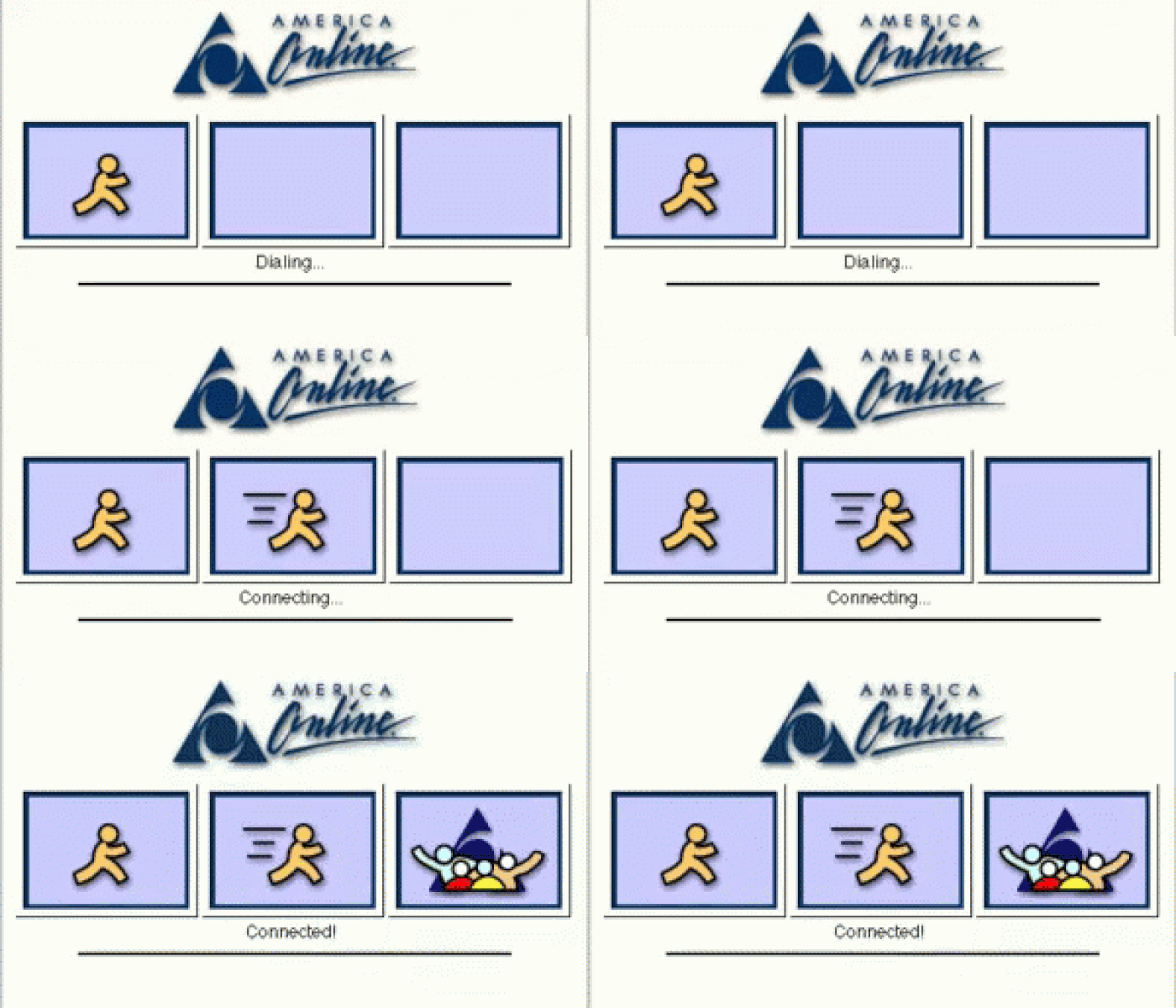
Source: Tenor.
AOL's 1996s Website Look (approximately taken on the 20th of December). Despite the extremely dated nature of the website, it's still very decorated and features a plentitude of options that the user could have explored and clicked on, including new articles updately frequently it seems, the most recent announcements, categories and graphics to get you interested in the services they had at the time, and their most popular websites under the "AOL Members' Choice" tag. Because of the simplicity of the website, some would argue that it even looks better; that is the case with most old vs modern websites—and things in general. The red borders plus the white background and navy blue coloring were likely due to the holiday season, especially the decorative images. However, the picture of the elderly couple on the top left is interesting—likely targeting their product towards that specific audience or was chosen to fit the aesthetic in a way—either of which is strangely very 90s.[12]
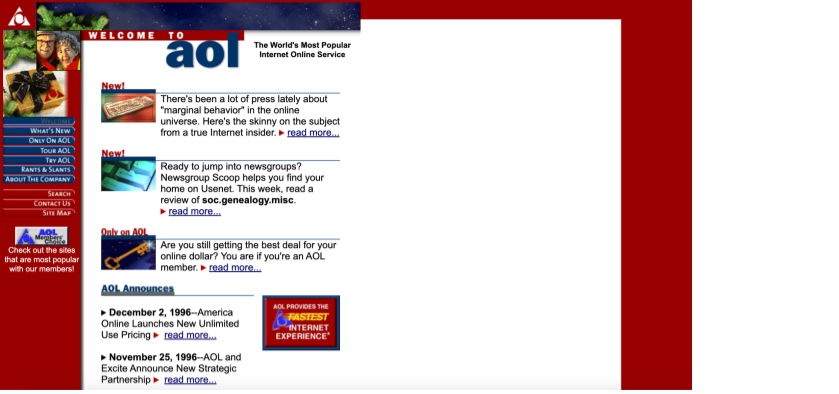
Source: Internet Archive.
AOL Seinfeld Promotional Graphic (very popular show of the 1990s)
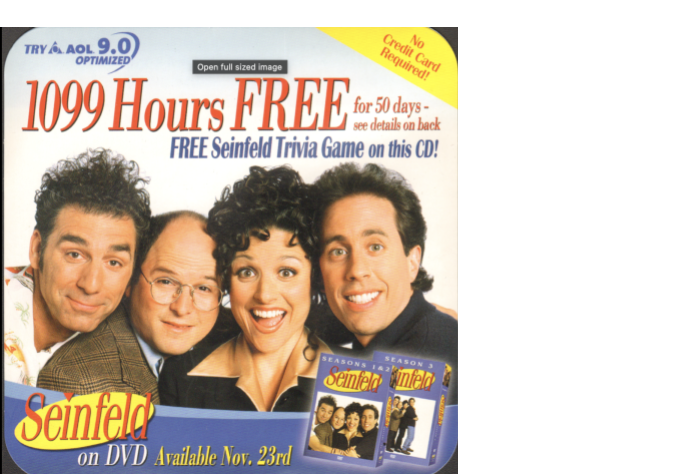
Source: Internet Archive.
[1] Source #1 (first contemporary source): New York Times
[2] Source #2 (second contemporary source): Britannica
[3] Source #3 (third contemporary source): 1000Logos
[4] Source #4 (first period source): Archive.org: AOL Video
[5] Source #5 (fourth contemporary source): Vice
[6] Source #6 (fifth contemporary source): "AOL.com"
[7] Source #7 (sixth contemporary source): "AOL"
[8] Source #8 (seventh contemporary source): WBEZ Chicago
[9] Source #9 (eigth contemporary source): Britannica
[10] Source #10 (first scholarly source): Matthew T. Bodie: AOL Time Warner and the False God of Shareholder Primacy
[11] Source #11 (second scholarly source): Elizabeth Zhao and Choate Rosemary Hall: The Dot-Com Bubble A Historical Perspective And A Cautionary Tale For The Age Of Ai
[12] Source #12 (second period source): Archive.org: AOL 1996 Website